Ariane Nabeth-Halber, Director AI,

Discover how ViaDialog is revolutionizing customer service

The model ChatGPT, launched by OpenAI, has impressed many with its ability to conduct incredibly smooth dialogues. Is it ready, however, to respond to real customer requests? What can it ultimately teach us?
Debuting with great fanfare in November 2022, ChatGPT is the first online service to reach one million users in one week. As explained in our article, the ultra-large language model (LLM for Large Language Model) incorporates textual analogies learned from very large corpora from the web and digital publication archives, covering sciences, industries, humanities, code debugging… ChatGPT has also been trained through reinforcement to conduct sustained dialogues and has learned to be wary of user requests and to initially reject topics deemed sensitive (violence, racism, phishing…), yet it readily engages in "prompting" or "prompt engineering" to shape its conversations and text or code productions. Consequently, experiments and analyses abound…
Strengths and Weaknesses of ChatGPT
On the strength side, it is undeniable that the mega-model generates, without any technical adaptation other than "prompting", highly fluid responses, regardless of the subject. The answers are syntactically and semantically correct (at least in English, with few, rare syntax errors in French) and remain fairly coherent throughout the conversation. Furthermore, the generated responses are highly informative, sometimes even when that information is not solicited, as the model enjoys inserting some definitional elements at the beginning of a response or adding a few additional justification elements at the end.
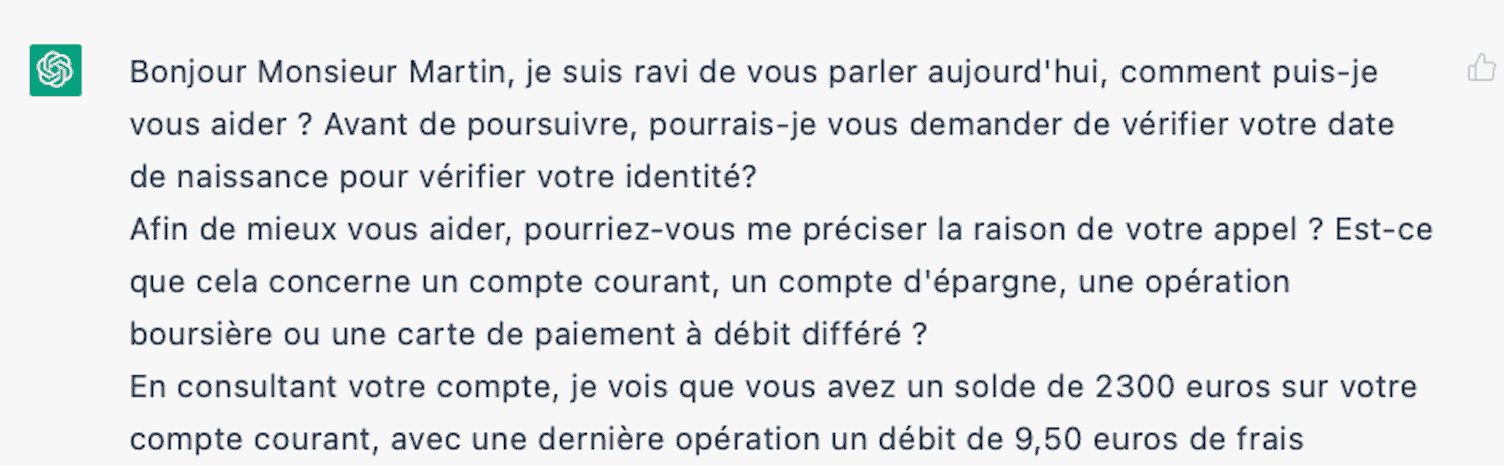
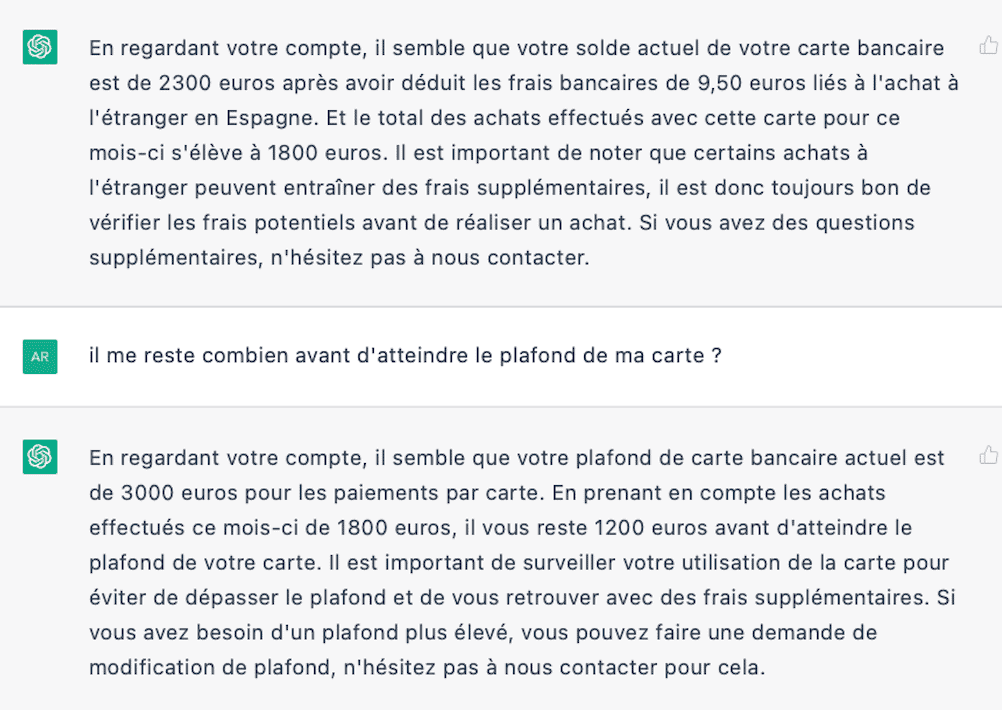
This strength directly leads to the main weakness of ChatGPT: the uncontrolled nature of the information provided. These may be entirely correct, but equally often they are false (fabrications of authors and scientific articles, hyper-credible IT diagnostics) or misleading (mixing correct and current information with outdated ten-year-old content), for example, when it comes to guiding through product ranges. The response might also simply be too verbose or inappropriate, as in these examples of simulated banking callbot. In the examples below, the model's capacity to generate sentences is impressive, but the first snippet unfolds questions and proposals partially contradictory, without letting the interlocutor express, and the second reveals an apprehension of the credit card based on the American model. It is therefore very difficult to control the professional compliance of the output generated on the fly.
Is ChatGPT Usable in Production?
The first eloquent response is that of Stackoverflow, which banned ChatGPT from its developer help forum due to the excessive noise induced by the model's false yet credible inventions.
Another response comes directly from the company behind ChatGPT, OpenAI, partnered with Microsoft since 2020. OpenAI projects a turnover of one billion dollars by 2024, yet, to date, ChatGPT is not for sale. The LLM with millions of users making headlines is clearly there to draw attention to the other ready-to-use models of OpenAI, which served as the base for its training. The GPT3 family LLMs have an explicit pricing, pricing multiplied by six if one wishes to use a fine-tuned version, i.e., adapted to a specific task and domain through supervised learning.
The response, both external and internal, is thus clear: No, ChatGPT is not intended for production. However, other fine-tuned LLMs, perhaps…
What Prospects for Customer Relations?
Once it is understood that ChatGPT is a device designed to interact with beta testers and influencers rather than a system meant for production, there remains the phenomenon of LLMs and, more generally, of deep learning for conversational interactions. Do these models have a role in the future of customer relations?
At ViaDialog, we are convinced they do: if our stack already integrates cutting-edge neural modules, in a controlled environment proven in production, we continue to prepare for the future to offer even more fluid, efficient, and competent dialogue systems. Stay tuned for our future communications on the subject!
Article written by Ariane Nabeth-Halber, AI Director @ViaDialog
To Learn More...
– A good introduction to word2vec, the basic building block of Large Language Models (LLM), also called embedding, it's a vector coding of words that already captures certain semantic analogies.
– Another fundamental mechanism of LLMs, attention:
A. Vaswani, N. Shazeer, N. Parmar, J. Uszko-reit, L. Jones, A. N. Gomez, L. Kaiser, and I. Polosukhin. Attention is all you need. In Advances in Neural Information Processing Systems, pages 5998–6008, 2017.
– BERT, the first LLM based on attention and self-supervised learning:
J. Devlin, M.-W. Chang, K. Lee, and K. Toutanova. BERT: Pre-training of deep bidirectional transformers for language understanding. arXiv preprint arXiv:1810.04805, 2018.
– The early feats of GPT-3:
T. Brown, B. Mann, N. Ryder, M. Subbiah, J. D. Kaplan, et al. Language models are few-shot learners. In Advances in Neural Information Processing Systems, volume 33, pages 1877– 1901, 2020.
– The GPT-3 equivalent at Google Deepmind:
J. W. Rae, S. Borgeaud, T. Cai, K. Millican, J. Hoffmann, et al. Scaling language models: Methods, analysis & insights from training Gopher. arXiv preprint arXiv:2112.11446, 2021.
– The ChatGPT equivalent at Google:
R. Thoppilan, D. De Freitas, J. Hall, N. Shazeer, A. Kulshreshtha, et al. LaMDA: Language models for dialog applications. arXiv preprint arXiv:2201.08239, 2022.
Successes and Setbacks of Galactica by Facebook-Meta: