
L’IA générative permet désormais de concevoir en quelques jours des applications qui auraient nécessité plusieurs mois de développement. Dans les centres de contact, cependant, l’interface logicielle ne représente qu’une partie de la valeur : infrastructure télécom, interconnexions opérateurs, données, traitements IA et disponibilité ne se génèrent pas avec un prompt.
Customer profiles, queue management, history, a "Call" button: with generative AI, a contact center interface can now be developed in a matter of days. The markets have absorbed this reality brutally: in January 2026, software vendors listed on Wall Street experienced their worst month since October 2008, with a 19% drop. Yet, successfully delivering 30 million calls per year, even on days when a data center goes down, remains the core business of operators and hosting providers. It is this layer, invisible during demonstrations, that sets platforms apart today.
Can generative AI replace contact center software?
Only in part. Generative AI accelerates everything related to code: screens, data models, workflows, reporting, and a portion of the business logic. A small team can now achieve in a few days what used to require several months of development. The stock market has partially corrected its panic since the spring, but the question facing buyers remains entirely unchanged.
On the other hand, AI does not produce telephone networks, interconnects with operators, or service continuity. For a Customer Relations Director or a CIO, the consequence is direct: demonstrations look increasingly similar, and the differences between two contact center software solutions lie beneath the interface, where a demonstration never goes.
What happens when an agent clicks "Call"?
The button is only the first link. Behind it, the call travels through the contact center application, the VoIP infrastructure, telecom routing, operator interconnects, and then the public telephone network before reaching the customer. At every step, signaling, audio streams, numbering, and monitoring must be managed without any perceptible disruption.
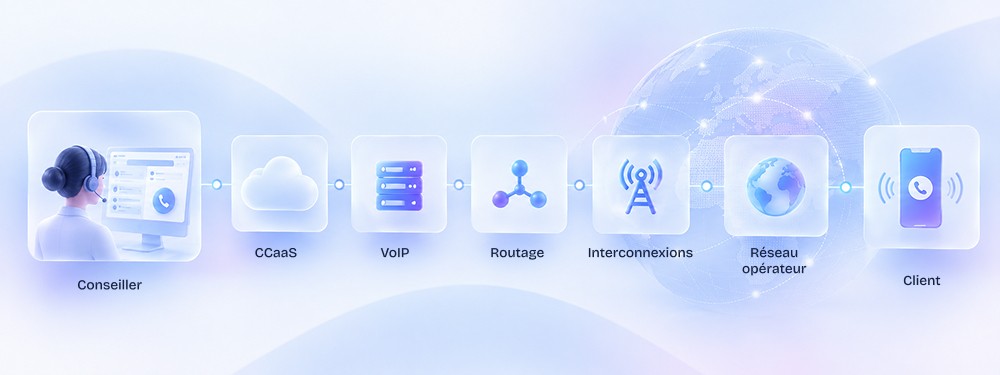
AI can generate the "Call" button. It cannot generate the network that allows the call to succeed. A vendor that is not an operator must purchase this entire chain from a third party, remaining dependent on them for both audio quality and incident resolution. ViaDialog is a registered operator with ARCEP: numbering, routing, and interconnects are managed by the same provider as ViaFlow, its omnichannel platform, from the telephone number right down to the AI model.
From prototype to production: what the demonstration does not show
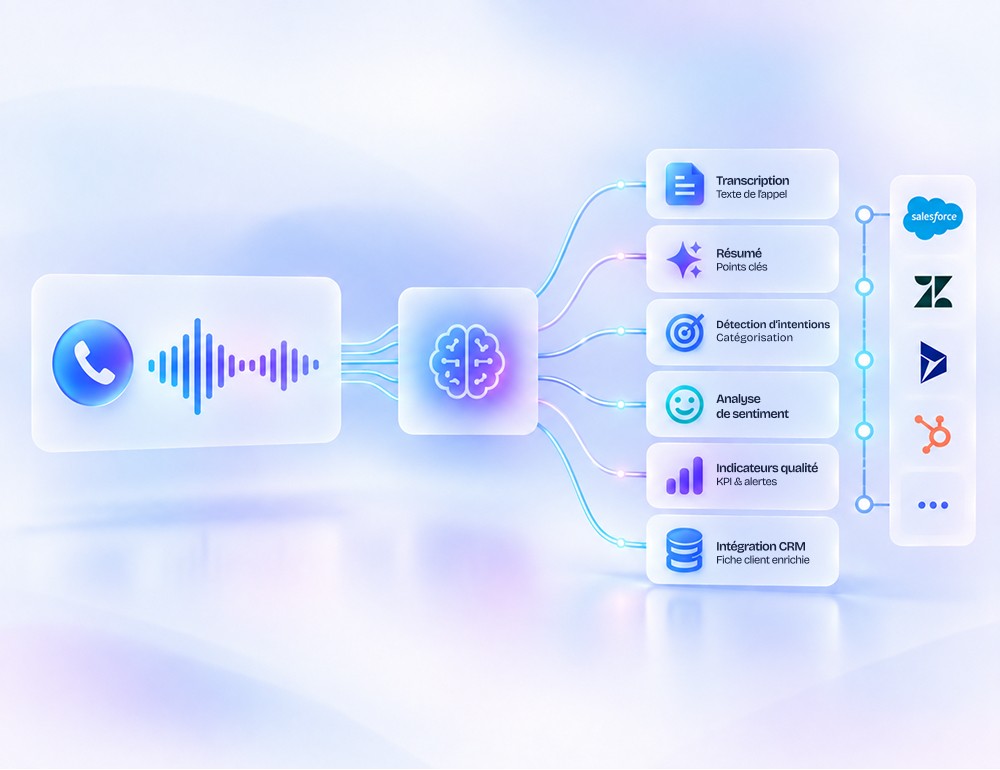
A prototype for automated summarization can be built quickly: a call, a transcription, an LLM, a summary. In production, the same processing must be applied to a large volume of simultaneous conversations. You have to capture audio streams, distinguish speakers, manage latency, control unit costs, and guarantee data protection at every stage.
At 30 million calls per year, every penny counts
At Société Générale, the ViaSpeech callbot is positioned at the start of the customer telephone journey. It understands the reason for the call in natural language and routes approximately 30 million calls annually to the correct department. At this scale, order of magnitude changes. An extra penny per interaction represents 300,000 euros per year. An additional second of processing time per call equates to more than 8,300 cumulative hours.
Annual volume does not dimension a platform
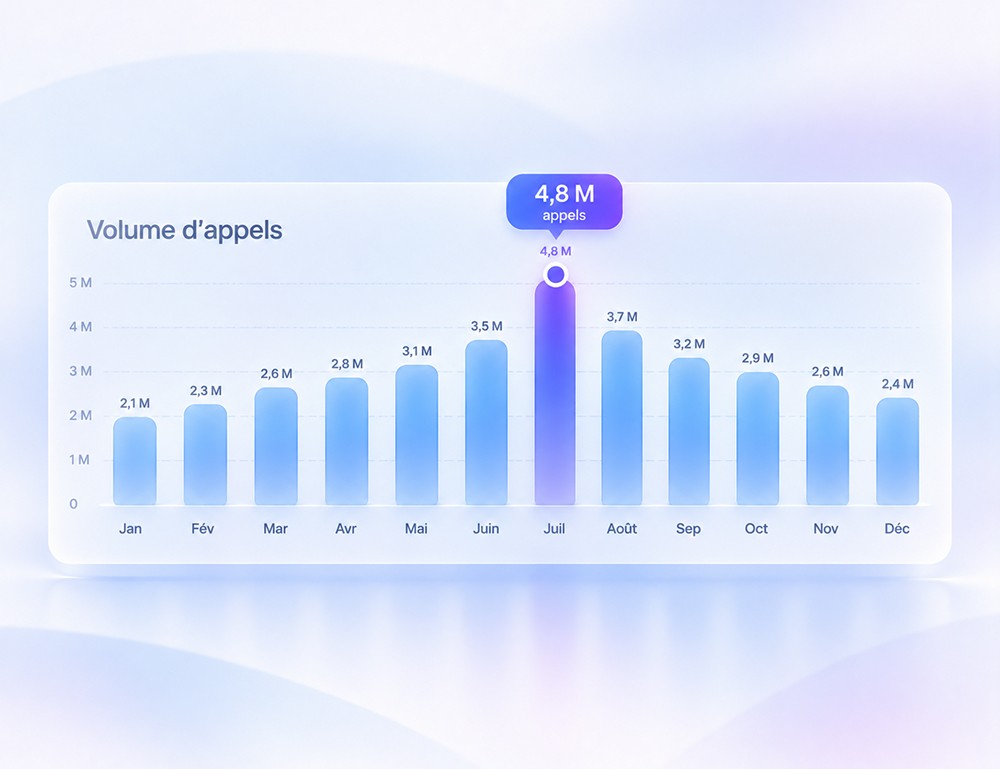
Calls do not arrive on average; they arrive in peaks: a Monday morning at a bank, the day after a hailstorm at an insurance company, or a strike day in transportation. The infrastructure must absorb these spikes, distribute traffic, and maintain service when a component or an entire site becomes unavailable. The transcription and analysis of conversations, handled by ViaBrain, add a processing load to every call: they must handle the same peak without degrading the experience of the customer on the line.
"Hosted in France" is not enough: four questions to ask a vendor
A contact center enhanced by AI no longer just generates calls. It produces recordings, transcriptions, summaries, customer intents, and quality scores—highly sensitive data whose complete journey must be understood. Storage location only describes one step of that journey.
1. Where do audio streams and transcriptions transit?
A call enters the network via an operator interconnect, reaches the platform, and is then recorded, transcribed, and analyzed. Each of these steps can take place with a different provider, sometimes outside of France. Ask for the complete list of intermediaries, not just the storage location. At ViaDialog, interconnects are operated by ViaDialog as an operator, and all processing runs by default in three data centers located in Île-de-France, at Ivry, Nanterre, and Aubervilliers.
2. Who operates the servers?
Two models coexist. A software vendor can run its platform with a hyperscaler, which provides and manages the infrastructure. Alternatively, they can operate their own equipment in specialized data centers: the data center provides the facility, power, cooling, and physical security, while the vendor retains control over the servers and the network. ViaDialog chose the second option. The implications for resilience and the governing data laws are detailed in our article on the hidden side of cloud infrastructure.
For a bank or an insurer, this question is also a regulatory one. The European DORA regulation, applicable since January 17, 2025, requires financial entities to maintain a register of all their ICT service contracts, submitted to the ACPR, and to assess concentration risk when a provider is difficult to replace. The shorter the subcontracting chain of a contact center, the simpler it is to document.
3. Which models process the conversations?
Transcription, natural language understanding, and text-to-speech can be outsourced to third-party APIs or operated internally. By default, ViaDialog's core technology (speech recognition, voice synthesis, language understanding) relies on proprietary engines running on its own infrastructure in France. If a client wishes to use a model or technology from an American provider, ViaDialog can integrate it upon request. This choice is explicit and made by the client, never imposed by the architecture.
4. What happens when a site goes down?
The three data centers operate in an active-active-active configuration: each processes traffic continuously, and the other two take over seamlessly if one goes down. ViaDialog is certified ISO 22301, the business continuity standard, and guarantees 99.99% availability.

What this changes in a CCaaS RFP
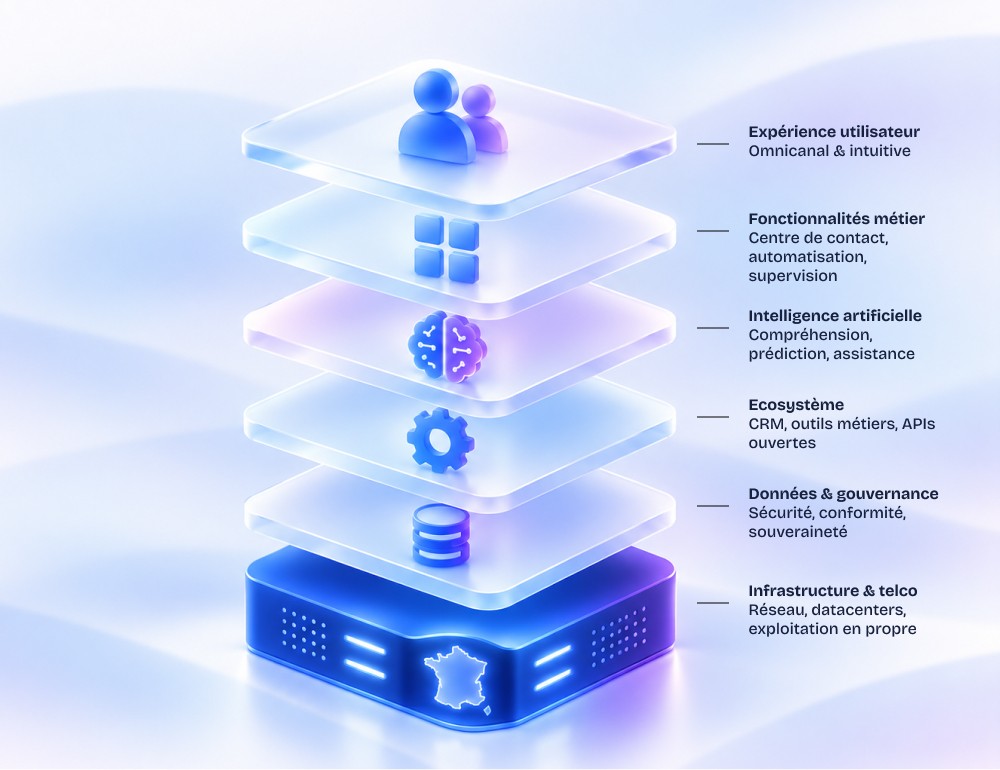
Visible features will continue to converge, as AI makes them faster to produce for all vendors. An evaluation scorecard that dedicates the majority of its points to demonstrations therefore compares what is copied fastest. What is hardest to copy lies beneath: operator status, self-operated infrastructure, proprietary AI engines, and the ability to handle peak volumes.
ViaDialog combines these three roles: software vendor, telecom operator, and hosting provider. By default, neither call routing nor data hosting depends on a hyperscaler. Every new use of AI, whether it is a callbot, real-time agent assistance, or systematic transcription, adds traffic and processing load to the layer transporting the conversations. The more interactions are enriched by AI, the more strategic the platform transporting them becomes.
Are you preparing an RFP or a migration? Review your architecture with a ViaDialog expert. Response within 24 business hours.
Frequently Asked Questions
Can you develop your own contact center software using AI?
For the interface and workflows, yes, and increasingly faster. For voice, however, you also need telecom infrastructure, operator interconnects, numbering, and continuous 24/7 operations. These elements must be purchased or built over several years; they cannot be automatically generated.
What value does a CCaaS vendor who is also a telecom operator bring?
They control numbering, routing, and interconnects instead of outsourcing them. The client has a single point of contact for call quality and incident resolution.
What is the difference between a CCaaS hosted with a hyperscaler and a CCaaS on proprietary infrastructure?
In the first scenario, the vendor rents processing capacity and depends on its provider for availability, costs, and processing locations. In the second, they operate their own servers in specialized data centers and control the entire chain.
Is a contact center affected by the DORA regulation?
For a bank or an insurer, yes: the contact center platform is an ICT service provided by a third party. It must be included in the information register required by DORA, and its substitutability enters into the assessment of concentration risk.
Why does the cost of AI depend so heavily on volume?
Because every processing task (transcription, summary, analysis) applies to every conversation. On 30 million calls per year, an extra penny per interaction represents 300,000 euros. The industrialization of processing is therefore just as critical as the feature itself.